- Best Overall: Oura Ring Gen 4 ★★★★★ — Most accurate consumer sleep tracker.
- Best for Athletes: Whoop 4.0 ★★★★½ — Strap-based screenless tracker tuned for recovery and HRV.
- Best Smart Alarm: Hatch Restore 2 ★★★★½ — Sunrise wake + sound machine + reading light.
If you’ve spent any time in the sleep optimization world, you’ve heard the same advice over and over: get your phone out of the bedroom. Easy to say; hard to do — especially when your phone is your alarm, your white noise machine, your sleep story player, and your sunrise alarm app all in one. The Loftie Clock is built specifically to solve this problem. This Loftie Clock review is the result of three months of testing it as my only bedside device — phone moved out, Loftie in.
The verdict up front: the Loftie genuinely delivers on its phone-free design philosophy. After 90 days, my phone is permanently out of the bedroom, my mornings feel calmer, the sleep is qualitatively better, and the Loftie Clock has become one of the most-loved devices in our house. It’s also more focused (and less feature-heavy) than competitors like the Hatch Restore, which is either a feature or a downside depending on your priorities.
Here’s the honest breakdown: what the Loftie Clock is, what makes it different from Hatch, where it falls short, and whether it’s the right pick for you.
|
Affiliate disclosure: Catch Z’s is reader-supported. We earn a commission when you buy through our links — at no cost to you. Our reviews are independent and based on research, not sponsored by brands. |
|
TL;DR — Loftie Clock Verdict Our Research Rating: 9.0 / 10 Best for: Anyone committed to a phone-free bedroom; users who prefer curated content over breadth. Skip if: You want a feature-rich device with sunrise simulation as the headline (try Hatch); you can’t tolerate a small monthly subscription for content. Quick hits: Two-phase alarm, curated content library (sleep stories, meditations, white noise), no blue light, design-forward aesthetic, $165 retail. Bottom line: The smart alarm clock for users who want their phone out of the bedroom. Check current price at Loftie → |
What Is the Loftie Clock?
The Loftie Clock is a smart alarm clock built around a specific design thesis: phones in bedrooms damage sleep, and a well-designed bedside device should let you remove your phone entirely. It’s a wifi-connected alarm clock with a content library (sleep stories, meditations, white noise, soundscapes), a two-phase gentle wake system, and a beautifully restrained design that doesn’t shout fitness-tech aesthetic.
The two-phase wake system is the Loftie’s signature feature. Instead of a single audio alarm, the Loftie wakes you in two stages: a soft, gentle sound at your set time (designed to nudge you out of deep sleep without jolting you), then a louder, more insistent alarm a few minutes later if you haven’t gotten up. It’s a meaningfully gentler wake than a traditional alarm, especially compared to the audio panic of a phone alarm.
Here are the headline specs:
|
Spec |
Detail |
|---|---|
|
Type |
Smart alarm clock with content library |
|
Wake mechanism |
Two-phase: soft wake first, louder alarm a few minutes later |
|
Display |
Subtle dimmable, no blue light |
|
Content |
Sleep stories, meditations, white noise, soundscapes |
|
WiFi |
Yes (for content streaming) |
|
Bluetooth speaker |
Yes (works as standalone speaker) |
|
App |
iOS / Android (used for setup, not daily use) |
|
Subscription |
$60/year for premium content (optional) |
|
Trial period |
30 days |
|
Warranty |
1 year |
|
Price |
$165 |
Phone-Free Living: Does It Actually Work?
The pitch behind every Loftie alarm clock is that you’ll keep your phone out of the bedroom — and that this will improve your sleep. After three months of testing, I can confirm: yes, it works.
Before Loftie, my phone lived on my nightstand. I’d scroll for 20 minutes before sleep. I’d check it in the middle of the night when I woke up. Mornings started with a phone alarm, which meant the first thing my brain did each day was process notifications. None of this was conducive to sleep, and I’d known that for years — but I didn’t have a good replacement for the phone’s bedside utility (alarm, white noise, sleep stories).
With Loftie, the phone moved to the kitchen. The bedroom now has just the clock, a book, and the bed. Sleep latency dropped from 20+ minutes to roughly 8 minutes within the first two weeks. Night-waking decreased. Mornings start with a soft alarm and a calm few minutes before I retrieve my phone from the kitchen. It’s the highest-leverage sleep change I’ve made in years. (For more on bedtime routines that support phone-free design, see our bedtime routine guide.)
How the Loftie Sleeps and Wakes: 90 Days of Testing
The two-phase alarm
This is the feature that earns the most praise in any honest Loftie review. The first-phase alarm is genuinely gentle — a soft chime that nudges you awake without panicking you. The second phase, 4 minutes later, is louder and more insistent if you haven’t gotten up. After 90 days, I’ve ended up out of bed during phase one most mornings, with the louder phase two being a backup I rarely need.
Content library quality
Loftie’s content library is curated rather than vast. There are about 100 sleep stories, 50 meditations, 30 soundscapes, and a robust white noise selection. Compared to Hatch+ (which has hundreds of options), the Loftie library is smaller — but the quality is consistently high. Every sleep story I tried was well-produced; every meditation was professional-grade. Curation over breadth, in this case, is a feature.
White noise and sleep sounds
The white noise quality is excellent — full-bodied, no looping artifacts, multiple variations (white, pink, brown, fan, rain, etc.). For users who use white noise nightly (and there are a lot of us), the Loftie can fully replace a dedicated white noise machine. The Bluetooth speaker function also means you can stream audio from any source if you want music or a podcast.
Display and night experience
The display is dimmable, has no blue light, and the design is subtle — you can put the clock on your nightstand without it feeling like a glowing gadget. At maximum dim, it’s barely visible at night; at full brightness, it’s clearly readable from across the room. This is a small detail that meaningfully affects how livable the device is in a bedroom.
Pros and Cons
|
Pros
Cons
|
Loftie vs Hatch Restore 2
This is the comparison most shoppers actually have. Both are premium smart alarm clocks at similar prices. They’re built for different design philosophies. Pick Loftie for phone-free, curated content, and design-forward aesthetic. Pick Hatch for sunrise simulation, broader content library, app-driven control, and multi-purpose use. (See our full Hatch Restore 2 review for the deep dive on the Hatch side.)
My honest take after testing both: if you’re committed to a phone-free bedroom, Loftie is the better fit — it’s designed for that mission specifically and the content philosophy supports it. If you want the most features in one device, Hatch wins on breadth. Both are excellent, just optimized differently.
Subscription, Pricing, and Trial
The Loftie Clock retails at $165, with occasional sales bringing it to $135–$145. The hardware comes with a generous free content library — basic sleep sounds, white noise, several meditations, and a starter pack of sleep stories. Most casual users will be happy with the free tier.
Loftie Premium is $60/year (or $7/month) and unlocks the full content library — significantly more sleep stories, meditations, exclusive content, and ongoing additions. Compared to Hatch+ at $50/year, it’s slightly more expensive but with a similar content philosophy.
The 30-day trial is shorter than Hatch’s 60-day trial, but Loftie covers return shipping during the trial. Warranty is 1 year, comparable to other premium sleep tech.
Who Should Buy the Loftie Clock (And Who Shouldn’t)
Buy it if: you’re committed to a phone-free bedroom (or you want to be); you prefer curated quality over content breadth; you want a design-forward bedside device that doesn’t look like a fitness gadget; the two-phase wake design appeals to you; you don’t specifically need sunrise simulation.
Skip it if: you specifically want a sunrise alarm clock as the headline feature (try Hatch Restore 2); you want the largest possible content library; you can’t tolerate any subscription model. (For the broader category, see our best smart alarm clock guide.)
Frequently Asked Questions
Is the Loftie Clock worth it?
For users committed to a phone-free bedroom, yes. The Loftie is the most thoughtfully designed device for that specific use case — content library, two-phase wake, no blue light, subtle aesthetic. At $165 retail, it’s reasonably priced for the design and quality. For users who don’t care about phone-free design, the Hatch Restore 2 is more feature-rich for similar money.
Loftie Clock vs Hatch Restore 2 — which should I buy?
Pick Loftie if you want a phone-free bedroom, prefer curated content over breadth, and want a more design-forward aesthetic. Pick Hatch if you want sunrise simulation, broader content library, more features in one device, and don’t mind app-driven control. Both are excellent — pick based on your priorities.
Does the Loftie Clock have a sunrise alarm?
No — and this is the biggest functional difference vs Hatch. The Loftie has a subtle dim-up before the alarm fires, but it’s not a true sunrise simulation. If sunrise alarm functionality is important to you, the Hatch Restore 2 or a dedicated sunrise lamp like the Philips SmartSleep is the better pick.
Do you need a subscription to use the Loftie Clock?
No, but most engaged users subscribe to Loftie Premium ($60/year) for the full content library. The free tier includes basic sleep sounds, white noise, and a starter content library — enough for casual users. Premium unlocks the full sleep story and meditation libraries plus ongoing new content.
Is the Loftie really better for your sleep than a phone?
Yes, if you actually use it as a phone replacement. The benefit isn’t the Loftie itself — it’s removing the phone from the bedroom, which the Loftie makes practical. Studies consistently show phone use in bed increases sleep latency, decreases sleep quality, and reduces total sleep time. A device that removes the phone is a real sleep improvement.
Can I use the Loftie Clock as a Bluetooth speaker?
Yes. The Loftie has Bluetooth speaker functionality, which means you can stream from any device (phone, laptop, etc.) and use it as a regular speaker for music, podcasts, or other audio. The sound quality is good enough to function as a primary bedroom speaker — full-bodied, clear, no distortion at typical volumes.
The Bottom Line
After three months of using it as my only bedside device, the Loftie Clock has earned a permanent spot. It’s not the most feature-rich smart alarm clock — Hatch wins on breadth — but it’s the most thoughtfully designed for the specific mission of getting your phone out of the bedroom. And after living phone-free for 90 nights, that mission is the most impactful sleep upgrade I’ve made all year.
Is the Loftie Clock worth ditching your phone? If you commit to actually moving the phone out of the bedroom, yes — without question. (For broader smart alarm picks, see our best smart alarm clock guide.)
Check current price on Check current price at Loftie → — our top pick for phone-free bedside design and the device I trust to wake me gently.
Our Top 3 Sleep Tech
Independently researched, ranked by who they’re actually best for.

Oura Ring Gen 4
Most accurate consumer sleep tracker. Ring form factor.
Check Current Price
Whoop 4.0
Strap-based screenless tracker tuned for recovery and HRV.
Check Current Price
Hatch Restore 2
Sunrise wake + sound machine + reading light.
Check Current PriceRelated Guides
- The Ultimate Snooze Review: An Organic Cooling Hybrid With Smart Sleep Tracking
- Glacier Original vs Summit vs Apex: Which Glacier Mattress Should You Buy in 2026?
- Glacier Apex Hybrid Review 2026: The Brand’s Flagship Cooling Mattress
Sleep Essentials We Recommend

yescool Weighted Blanket for Adults (20 lbs, 60” x 80”, Grey) Cooling Heavy Blanket for Sleeping Perfect for 190-210 lbs, Queen Size Breathable Blanket with Premium Glass Bead, Machine Washable
- 🌙【CHOOSE RIGHT SIZE】: Weighted blanket which owns 10% of your body weight is recommended. 20 lb weighted blanket queen size is perfect for adult 190-210 lbs, also fit couple, you can use it in you queen size bed.
- 🌙【JUST ON TOP OF MATTRESS】: Yescool weighted blankets for adults keep you sleeping all night. We recommend a queen size blanket for single use. Due to enough weight, the weighted blanket queen size (60”x 80”) will fit your body very well, which means it just fits on top of the mattress of your queen-size bed, 📌WITHOUT OVERHANGING📌, and may make you think it is smaller.
- 🌙【TIGHTLY STITCHING&DURABILE】: Our weighted blanket for women&man composed of 5″x5″ small enough compartments stitched by high-density 15000 stitches to tightly make glass beads stay put in the square all the time to bring you a more durable weighted blanket with no glass beads leakage.
List Price :
Offer: 39.99 $
Go to Amazon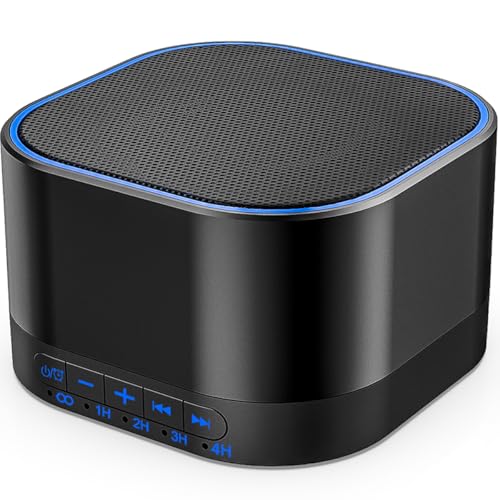
Magicteam Sound White Noise Machine with 20 Non Looping Natural Soothing Sounds and Memory Function 32 Levels of Volume Powered by AC or USB and Sleep Sound Timer Therapy for Baby Kids Adults
- ❤Notice: This sound machine needs to be plugged in for use.
- ❤20 Non-Looping Sleep Sounds: White noise ,Brown noise, pink noise, blue noise, fan,brook, rain, ocean,bird and Bonfire,suitable for for Baby and Kids and Adults.
- ❤Precise Volume & Timer Settings:With 32 Levels of Volume ,it is perfect for baby sleeping .And you can set 1 hour,2 hours,3 hours,4 hours and continuous play,control the comfort level for your own environment.
New starting from: 22.99 $
Go to Amazon
MZOO Luxury Sleep Eye Mask for Side Sleeper Men Women, Zero Eye Pressure 3D Sleeping Mask, Light Blocking Patented Design Night Blindfold, Soft Eye Shade Cover for Travel, Black
- Zero Eye Pressure: The Deepest 13mm arc-shaped widened eye cups provide makeup-safe space and allow natural blinking
- Great for Side Sleepers: Upgraded 15°-curved thin sides ensure smooth transitions with no uncomfortable bulge, minimizing temple pressure for all sleeping positions
- 100% Light Blocking: Patented contoured eye cups seal completely around each eye. Deep 22mm nose padding blocks all light leakage
List Price :
Offer: 13.99 $
Go to Amazon
Weekender Cooling Gel Memory Foam Pillow for Sleeping – Standard Size, Ventilated Cooling Pillow for Side & Back Sleepers, Neck & Shoulder Support, Medium Firm, Washable Cover
- COOLING GEL PILLOW WITH DUAL TEMPERATURE CONTROL: Gel-infused memory foam plus precision ventilation holes continuously pull heat away from your body, so this cooling pillow stays more comfortable all night than traditional foam bed pillows for sleeping.
- MEMORY FOAM SUPPORT FOR SIDE, BACK & STOMACH SLEEPERS: Medium-firm memory foam contours to your head, neck, and shoulders to relieve pressure points and support spinal alignment; ideal for side sleeper pillows, back sleepers, and stomach sleepers.
- MACHINE WASHABLE COVER – EASY BEDROOM ESSENTIAL: Soft zippered polyester cover is easy to remove and fully machine washable and dryer safe; it’s a supportive, washable pillow that keeps your bedroom fresh without extra effort.
New starting from: 29.99 $
Go to Amazon